La tangente hiperbólica y la teoría de la relatividad


tanh(x)=v/c


coth(x)=c/v = Ep(r)= Energía Potencial gravitatoria en función de la distancia (r)


Proper velocity

Log-log plot of γ (blue), v/c (cyan), and η (yellow) versus proper velocity w/c (i.e. momentum p/mc). Note that w/c is tracked by v/c at low speeds and by γ at high speeds. The dashed red curve is γ − 1 (kinetic energy K/mc2), while the dashed magenta curve is the relativistic Doppler factor.
For example, proper velocity equals momentum per unit mass at any speed, and therefore has no upper limit. At high speeds, as shown in the figure at right, it is proportional to an object's energy as well.
Proper velocity w = dx/dτ is the product of two other derivatives in special relativity that describe an object's rate of travel: coordinate velocity v = dx/dt and the Lorentz factor γ = dt/dτ. For unidirectional motion, each of these is also simply related to a traveling object's hyperbolic velocity angle or rapidity η by
- .

Contents
Introduction[edit]
In flat spacetime, proper velocity is the ratio between distance traveled relative to a reference map frame (used to define simultaneity) and proper time τ elapsed on the clocks of the traveling object. It equals the object's momentum p divided by its rest mass m, and is made up of the space-like components of the object's four-vector velocity. William Shurcliff's monograph[1] mentioned its early use in the Sears and Brehme text.[2] Fraundorf has explored its pedagogical value[3] while Ungar,[4] Baylis[5] and Hestenes[6] have examined its relevance from group theory and geometric algebra perspectives. Proper velocity is sometimes referred to as celerity.[7]Unlike the more familiar coordinate velocity v, proper velocity is synchrony-free[1] (does not require synchronized clocks) and is useful for describing both super-relativistic and sub-relativistic motion. Like coordinate velocity and unlike four-vector velocity, it resides in the three-dimensional slice of spacetime defined by the map frame. As shown below and in the example figure at right, proper-velocities even add as three vectors with rescaling of the out-of-frame component. This makes them more useful for map-based (e.g. engineering) applications, and less useful for gaining coordinate-free insight. Proper speed divided by lightspeed c is the hyperbolic sine of rapidity η, just as the Lorentz factor γ is rapidity's hyperbolic cosine, and coordinate speed v over lightspeed is rapidity's hyperbolic tangent.

Imagine an object traveling through a region of spacetime locally described by Hermann Minkowski's flat-space metric equation (cdτ)2 = (cdt)2 − (dx)2. Here a reference map frame of yardsticks and synchronized clocks define map position x and map time t respectively, and the d preceding a coordinate means infinitesimal change. A bit of manipulation allows one to show that proper velocity w = dx/dτ = γv where as usual coordinate velocity v = dx/dt. Thus finite w ensures that v is less than lightspeed c. By grouping γ with v in the expression for relativistic momentum p, proper velocity also extends the Newtonian form of momentum as mass times velocity to high speeds without a need for relativistic mass.[8]
Proper velocity addition formula[edit]
The proper velocity addition formula:[9][10][11]

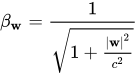
This formula provides a proper velocity gyrovector space model of hyperbolic geometry that uses a whole space compared to other models of hyperbolic geometry which use discs or half-planes.
In physics notation, therefore, local proper-velocities w ≡ dx/dτ add as 3-vectors[12] much like coordinate-velocities at low speed, provided that we rescale the magnitude of the "out-of-frame" vector. In other words:
- ,

- .

Relation to other velocity parameters[edit]
Speed table[edit]
The table below illustrates how the proper velocity of w = c or "one map-lightyear per traveler-year" is a natural benchmark for the transition from sub-relativistic to super-relativistic motion.| Condition/Parameter | Coordinate velocity v dx/dt in units of c | Velocity angle η in i-radians | Proper velocity w dx/dτ in units of c | Lorentz factor γ dt/dτ = E/mc2 |
|---|---|---|---|---|
| Traveler stopped in map-frame ⇔ 1 map-year/traveler-year | 0 | 0 | 0 | 1 |
| Momentum = ½mc ⇔ 0.5 map-lightyear/traveler-year | 1/√5 ≅ 0.447 | ln[(1 + √5)/2] ≅ 0.481 | ½ | √5/2 ≅ 1.118 |
| Rapidity of 0.5 hyperbolic radian | (e − 1)/(e + 1) ≅ 0.462 | ½ | ½(√e − 1/√e) ≅ 0.521 | ½(√e + 1/√e) ≅ 1.128 |
| Coordinate velocity = ½c ⇔ 0.5 map-lightyear/map-year | ½ | ½ln[3] ≅ 0.549 | 1/√3 ≅ 0.577 | 2/√3 ≅ 1.155 |
| Momentum = mc ⇔ 1 map-lightyear/traveler-year | 1/√2 ≅ 0.707 | ln[1 + √2] ≅ 0.881 | 1 | √2 ≅ 1.414 |
| Rapidity of 1 hyperbolic radian | (e2 − 1)/(e2 + 1) ≅ 0.761 | 1 | ½(e − 1/e) ≅ 1.175 | ½(e + 1/e) ≅ 1.543 |
| Kinetic energy = mc2 ⇔ 2 map-years/traveler-year | √3/2 ≅ 0.866 | ln[√3 + 2] ≅ 1.317 | √3 ≅ 1.732 | 2 |
| Momentum = 2mc ⇔ 2 map-lightyears/traveler-year | 2/√5 ≅ 0.894 | ln[2 + √5] ≅ 1.444 | 2 | √5 ≅ 2.236 |
| Rapidity of 2 hyperbolic radians | (e4−1)/(e4+1) ≅ 0.964 | 2 | ½(e2 − 1/e2) ≅ 3.627 | ½(e2 + 1/e2) ≅ 3.762 |
| Coordinate velocity = c ⇔ 1 map-lightyear/map-year | 1 | ∞ | ∞ | ∞ |
Interconversion equations[edit]
The following equations convert between four alternate measures of speed (or unidirectional velocity) that flow from Minkowski's flat-space metric equation:- .

Lorentz factor γ: energy over mc2 ≥ 1[edit]

Proper velocity w: momentum per unit mass[edit]

Coordinate velocity: v ≤ c[edit]

Hyperbolic velocity angle or rapidity[edit]

- .

Applications[edit]
Comparing velocities at high speed[edit]
Proper velocity is useful for comparing the speed of objects with momentum per unit rest mass (w) greater than lightspeed c. The coordinate speed of such objects is generally near lightspeed, whereas proper velocity tells us how rapidly they are covering ground on traveling-object clocks. This is important for example if, like some cosmic ray particles, the traveling objects have a finite lifetime. Proper velocity also clues us in to the object's momentum, which has no upper bound.
For example, a 45 GeV electron accelerated by the Large Electron–Positron Collider (LEP) at Cern in 1989 would have had a Lorentz factor γ of about 88,000 (45 GeV divided by the electron rest mass of 511 keV). Its coordinate speed v would have been about sixty four trillionths shy of lightspeed c at 1 lightsecond per map second. On the other hand, its proper speed would have been w = γv ~ 88,000 lightseconds per traveler second. By comparison the coordinate speed of a 250 GeV electron in the proposed International Linear Collider[13] (ILC) will remain near c, while its proper speed will significantly increase to ~489,000 lightseconds per traveler second.
Proper velocity is also useful for comparing relative velocities along a line at high speed. In this case

Hence each of two electrons (A and C) in a head-on collision at 45 GeV in the lab frame (B) would see the other coming toward them at vAC ~ c and wAC = 88,0002(1 + 1) ~ 1.55×10¹⁰ lightseconds per traveler second. Thus from the target's point of view, colliders can explore collisions with much higher projectile energy and momentum per unit mass.
Proper velocity-based dispersion relations[edit]

To illustrate, the figure at right with log-log axes shows objects with the same kinetic energy (horizontally related) that carry different amounts of momentum, as well as how the speed of a low-mass object compares (by vertical extrapolation) to the speed after perfectly inelastic collision with a large object at rest. Highly sloped lines (rise/run = 2) mark contours of constant mass, while lines of unit slope mark contours of constant speed.
Objects that fit nicely on this plot are humans driving cars, dust particles in Brownian motion, a spaceship in orbit around the sun, molecules at room temperature, a fighter jet at Mach 3, one radio wave photon, a person moving at one lightyear per traveler year, the pulse of a 1.8 MegaJoule laser, a 250 GeV electron, and our observable universe with the blackbody kinetic energy expected of a single particle at 3 kelvin.
Unidirectional acceleration via proper velocity[edit]
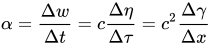
Proper acceleration at any speed is the physical acceleration experienced locally by an object. In spacetime it is a three-vector acceleration with respect to the object's instantaneously varying free-float frame.[15] Its magnitude α is the frame-invariant magnitude of that object's four-acceleration. Proper acceleration is also useful from the vantage point (or spacetime slice) of external observers. Not only may observers in all frames agree on its magnitude, but it also measures the extent to which an accelerating rocket "has its pedal to the metal".In the unidirectional case i.e. when the object's acceleration is parallel or anti-parallel to its velocity in the spacetime slice of the observer, the change in proper velocity is the integral of proper acceleration over map time i.e. Δw = αΔt for constant α. At low speeds this reduces to the well-known relation between coordinate velocity and coordinate acceleration times map time, i.e. Δv = aΔt. For constant unidirectional proper acceleration, similar relationships exist between rapidity η and elapsed proper time Δτ, as well as between Lorentz factor γ and distance traveled Δx. To be specific:
- ,
- .

Se considera una velocidad relativista aquella que representa un porcentaje significativo de la velocidad de la luz y que por ello obliga a tener en cuenta los efectos de la relatividad especial a la hora del estudio científico.
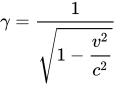
Se llaman partículas relativistas a las partículas elementales que se mueven a velocidades relativistas. Cuando la velocidad de una partícula es un porcentaje significativo de la velocidad de la luz aparecen diversos efectos relativistas importantes como la dilatación temporal o la contracción de longitudes. Una magnitud que mide adecuadamente estos efectos relativistas de la velocidad es el factor de Lorentz
Para el factor de Lorentz difiere en más de un 2% de la unidad, y por tanto, tiene efectos claramente medibles, pero sólo para velocidades el efecto relativista se aleja de las predicciones de la mecánica clásica más de un 50%.


Comentarios
Publicar un comentario